Analyzing the mechanisms of societal stability and transformation.
Tenured Professor at the Public University of Navarra (UPNA) and Coordinator of the CSIC Associated Unit 'TecPoliS'. His research focuses on the dynamics of global governance, collective security, and sociology.
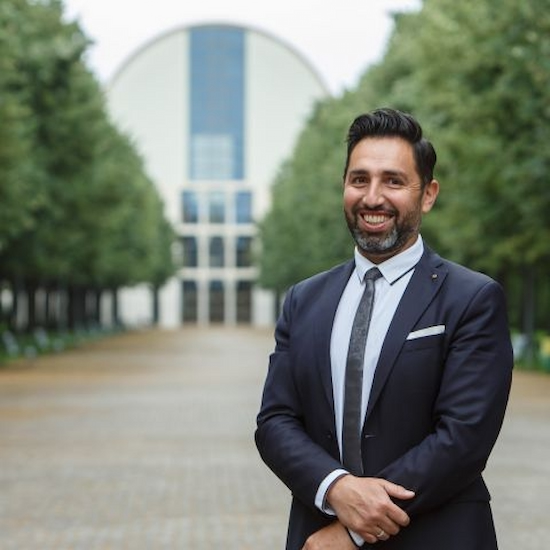
Sergio García Magariño holds a PhD in Sociology with international mention and is a Tenured Professor of Political Science and Public Administration at the Public University of Navarra (UPNA), where he also coordinates the Associated Unit to the CSIC 'TecPoliS' (Sustainable Technologies, Policies, and Societies). He has two recognized research periods (sexenios) and is a researcher at UPNA's Institute for Advanced Social Research (I-Communitas). His scientific work is complemented in the field of global governance ('governance') and social development by collaborations with other entities, having previously served as an associate researcher at the Institute of Democratic Governance (Globernance). He has conducted research and teaching stays at prestigious international institutions such as Cornell University, University College Dublin, and the University of Essex.
He is also a consultant professor at Nur University in Bolivia, a permanent international scholar at Cornell University, and was appointed visiting professor at University College Dublin (2022-2024). Some of his research lines cover violent radicalization processes, good governance mechanisms, collective security, social and economic development, and issues related to the sociology of science and religion, reflected in more than ninety academic articles and books. He is a regular contributor to written and audiovisual media. Recently, he was selected as one of the 100 most outstanding lecturers in Spain (2020-2021) by Thinking Heads and has coordinated the international project Xenometer, in collaboration with Cornell University, to design an algorithm that detects xenophobic messages on social networks.
Research is not a mere accumulation of data, but a moral imperative to clarify the structures that bind us.
In an era of increasing polarization, sociology must remain a bastion of objective inquiry. My philosophy centers on dissecting radicalization not through the lens of condemnation, but through the rigorous mapping of cognitive and social causality.
Society is built upon invisible architectures. Governance is the study of how these structures distribute power and meaning. I investigate how institutional frameworks can adapt to the pluralistic demands of the 21st century.
The dichotomy between the sacred and the secular is increasingly blurred. My research explores how religious phenomena continue to shape public policy and social cohesion, often in ways that traditional political science fails to capture.
Academic work must transcend the journal page. It has a duty to inform public policy and civil discourse, providing a sober foundation for the complex decisions facing modern democratic states.
Explore current research projects
Detailed insights into ongoing studies on radicalization and social integration.